
Stay, Stretch or Step Away™ A Mid-Career Decision Framework for Women Who Feel Stuck
One of the hardest career decisions you’ll ever make isn’t whether to leave.
It’s understanding why you want to leave in the first place.
The Career Decision You’re Trying to Make May Not Be the Real Decision
One of the questions I hear most often in coaching is…
“Caron… I don’t know whether I should stay or leave.”
By the time women ask me that question, they’ve usually spent months, sometimes years, thinking it through. They’ve weighed up the pros and cons. Updated their LinkedIn profile more than once. Browsed seek late at night and imagined what life might look like somewhere else. They have convinced themselves that a new organisation, a different manager or a fresh start will finally make them feel motivated again.
Sometimes they’re right.
But more often than not, the job isn’t the real issue.
After coaching hundreds of mid-career women over the past eight years, I’ve noticed something that surprised even me. If I looked back across the women I’ve worked with, I’d estimate that around 10% discovered they were actually in the right place and simply needed a fresh perspective.
Around 15% realised it was genuinely time to move on because the organisation, culture or role no longer aligned with their values or wellbeing.
But the overwhelming majority around 75% didn’t need a new job. They needed to stretch.
Not by working longer hours. Not by collecting another qualification and not by proving themselves all over again.
They needed to become the next version of themselves. That observation completely changed the way I coach.
Today, I rarely begin by asking, “Should you leave?”
Instead, I ask a different question.
“What is this season of your career asking of you?”
Because that question opens up possibilities that simply don’t exist when we’re trapped in an either-or decision.
I think one of the biggest myths we’ve been sold is that career decisions are logical. As if we simply gather enough information, compare our options and arrive at the “right” answer. But careers don’t work like that. Careers are deeply personal and shaped by our experiences, our identity, our values, our relationships and, perhaps most importantly, by who we are becoming.
That’s why the same job can feel energising to one person and completely draining to another and why the advice that worked ten years ago may no longer fit the woman you are today.
When women come to coaching, they often tell me they’re looking for clarity. When what they’re really looking for is PERMISSION.
Permission to want something different.
Permission to admit they’re no longer fulfilled.
Permission to stop carrying everyone else’s expectations.
Permission to imagine a future that looks different from the one they carefully built over the last twenty years.
Why Most Women Think the Choice Is Stay or Leave
One of the biggest mistakes I see women make is believing there are only two options.
Stay. Or leave.
It sounds obvious, but this is a classic example of what psychologists call black-and-white thinking—our tendency to see situations in extremes rather than recognising the possibilities that sit between them.
When work feels difficult, we instinctively start looking for the exit.
“Maybe I need a new organisation.”
“Maybe I chose the wrong career.”
“Maybe I just need a fresh start.”
Sometimes that’s true.
But often, it’s not. One of the questions I ask clients is:
“What have you already done to change your experience before deciding to change your employer?”
It’s a confronting question. Because very often, the answer is…
“Not much.” Not because they’re passive. Far from it. Most of the women I work with are incredibly capable. They’re the ones holding teams together. Supporting colleagues. Delivering results. Keeping everyone else afloat. The problem isn’t a lack of effort. It’s where that effort is directed.
Instead of having the difficult conversation with their manager, they keep hoping things will improve.
Instead of asking for different opportunities, they quietly accept the status quo.
Instead of setting boundaries, they continue absorbing more work.
Instead of making themselves visible, they keep waiting to be noticed.
And slowly, almost without realising it, they begin putting themselves last.
I’ve seen women spend six months researching new jobs when what they really needed was one courageous conversation with their leader.
I’ve also seen women convince themselves they had to resign when the organisation would happily have redesigned their role—if only someone had known there was a problem.
Of course, not every workplace is willing to change.
Some cultures are exactly as they appear.
We’ll come to that later. But I’ve learnt that women deserve something before they make a life-changing career decision. They deserve clarity.
Not clarity about whether another employer might be better. Clarity about what is really driving the desire to leave.
Because if you don’t understand that, there’s every chance you’ll take the same patterns, the same frustrations and the same unanswered questions into your next role.
And six months later, you’ll be asking yourself exactly the same question.
“Should I stay… or should I leave?”
The answer may have very little to do with your job at all.
“Most women don’t need a new job. They need the perspective and capacity to recognise who they’re becoming—and the courage to let their career reflect that.”
If you’re not sure what’s really driving your career dissatisfaction, it can help to start with greater self-awareness. Take my free Career Persona Quiz to discover your unique career persona and uncover what’s most likely holding you back whether that’s your environment, your mindset, or the next stage of your growth.
Introducing the Stay • Stretch • Step Away™ Framework
After years of coaching women through career transitions, I’ve come to believe that most career decisions aren’t actually about choosing between one organisation and another.
They’re about understanding what your current season of life is asking of you.
When I first started coaching, I assumed my role was to help people make better career decisions.
Over time, I realised that wasn’t quite right. The women sitting opposite me rarely lacked intelligence. They didn’t lack experience, motivation or ambition. If anything, they had spent years doing all the “right” things. They had built successful careers, earned promotions, taken on more responsibility and become the dependable person everyone relied on.
Yet many still felt stuck. Not because they didn’t know what to do. Because they couldn’t see themselves clearly anymore. That changed the way I coach. Coaching the person more than the goal.
Today, I’m less interested in helping someone decide whether to accept a new job.
I’m far more interested in helping them understand what’s really driving the decision. Because leaving isn’t always growth. And staying isn’t always settling. Sometimes the bravest thing you can do is stretch into a version of yourself you’ve been avoiding.
I’ve also noticed something else. Women often arrive in coaching convinced they need answers and what they really need is perspective.
Perspective helps us separate what belongs to us from what belongs to the environment. It helps us distinguish between temporary frustration and genuine misalignment. It allows us to see whether we’re reacting to fear, fatigue or a deeper sense that we’ve outgrown our current role.
That’s where this framework comes in.
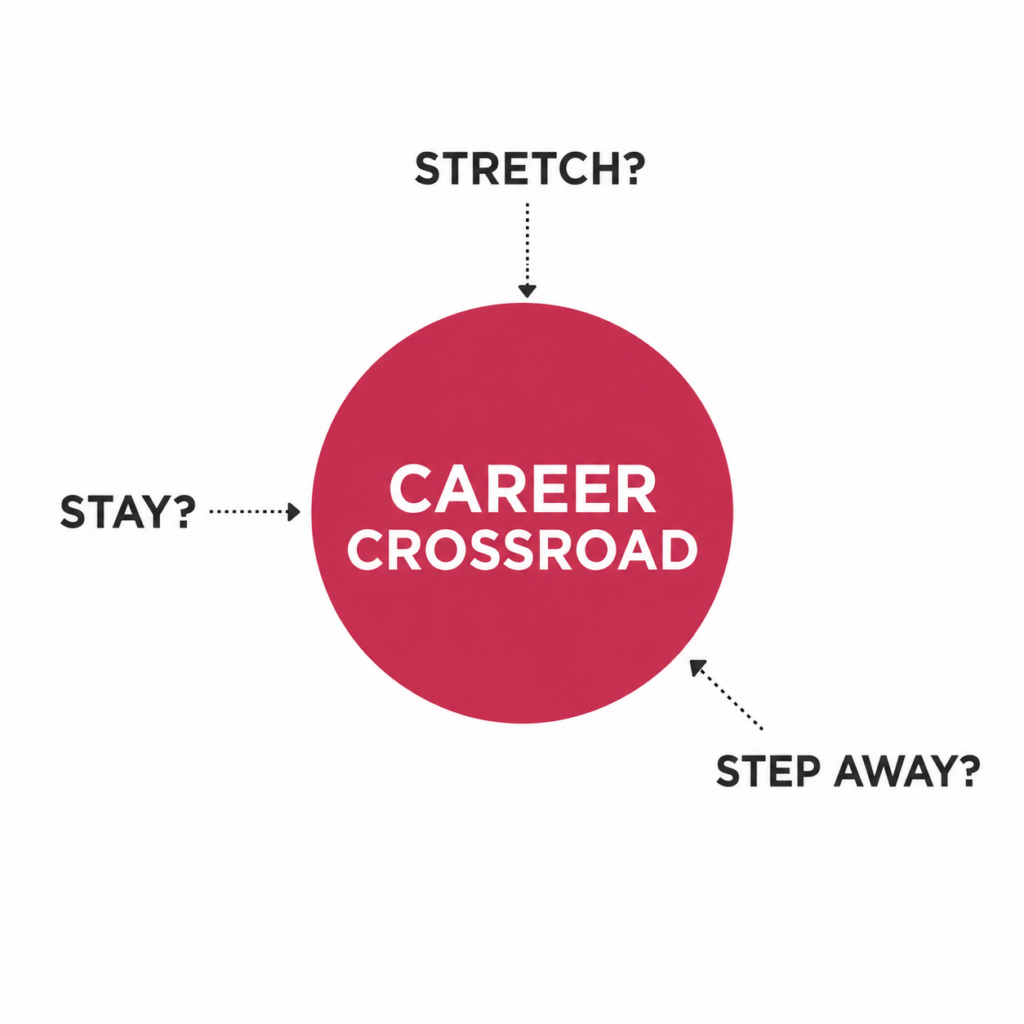
I call it Stay • Stretch • Step Away
It’s not designed to tell you what decision to make. Rather, it is designed to help you ask better questions before you make a decision. Because better questions almost always lead to better decisions.
The Stay • Stretch • Step Away Framework
|
Stay |
Stretch |
Step Away |
|---|---|---|
|
You still believe in the organisation’s purpose and values. |
You’re capable of more than you’re currently allowing yourself to believe. |
|
|
Fear is driving your decision more than facts. |
You’re waiting for confidence before taking action. |
The emotional cost of staying has become too high. |
|
You haven’t yet had the conversations that could change your experience. |
You’re playing small, shrinking yourself or hoping someone notices your potential. |
You’ve explored reasonable options, but the environment isn’t changing. |
|
There are still opportunities to grow where you are. |
The next step requires courage rather than another qualification. |
You’re surviving rather than thriving. |
|
You need a different perspective, not necessarily a different employer. |
Your identity hasn’t caught up with your capability. |
You’ve outgrown the environment and can no longer do your best work. |
Stay Doesn’t Mean Settling
Let’s start with the option that often surprises people. Sometimes staying is exactly the right decision. Not because you’re afraid to leave or because you’ve become comfortable. But because there’s still something valuable to learn where you are.
I’ve coached women who were convinced they needed to resign. They were frustrated, exhausted and already imagining life somewhere else. As we worked together, something became clear. The organisation wasn’t the problem. Their perspective had narrowed. They had become so consumed by what wasn’t working that they’d stopped seeing the opportunities that were still available to them.
Sometimes staying means changing the story you’re telling yourself. Sometimes it means recognising that you’re making a decision from fear rather than facts.
One of the questions I often ask is:
“If fear wasn’t part of this decision, what would you do?”
The answer can be incredibly revealing.
Fear has a way of convincing us that the grass must be greener somewhere else.
Sometimes it can be.
However, a lot of the time it’s simply easier to imagine another organisation changing our experience than it is to change the way we’re showing up in the one we’re already in.
That isn’t always comfortable to hear. But it’s often where growth begins
Stretch Is Where Most Women Discover Their Next Chapter
This is where the vast majority of my clients find themselves. Not at the point of leaving but not completely content. Somewhere in the middle. They are capable, experienced and respected, yet quietly holding themselves back.
They’re waiting until they feel more confident before applying for the promotion.
Waiting until they’re completely ready before putting their hand up for a leadership opportunity.
Waiting until someone notices how capable they are.
Waiting until life becomes less busy.
Waiting until they know more.
Waiting until the timing feels perfect.
The trouble is, confidence rarely arrives before action.
It usually follows it.
Stretching doesn’t always involve changing jobs. Often it means changing the relationship you have with yourself. It’s having the difficult conversation you’ve been avoiding.
It’s setting the boundary you’ve convinced yourself isn’t possible.
It’s becoming more visible instead of hoping your hard work speaks for itself.
It’s backing your judgement.
Trusting your experience.
Allowing yourself to think bigger.
One of the most rewarding moments in coaching is watching a woman realise that the career she’s been waiting for isn’t somewhere else. It’s on the other side of becoming more fully herself.
Coaching Story
One client came to me convinced she needed to resign. She felt overlooked, frustrated and certain that another organisation would appreciate her more. As we unpacked her situation, a different picture emerged. She had never told her manager she wanted to a certain lead project. She’d never asked for step up opportunities. She assumed people knew she was ambitious because of the quality of her work. They didn’t. Together, we worked on building her confidence, clarifying her aspirations and preparing for what felt like an incredibly uncomfortable conversation.
That one conversation changed everything.
Within months she was leading strategic work she’d previously only dreamed about. The organisation hadn’t changed. She had.
I think that’s one of the most important lessons I’ve learned as a coach.
Sometimes the breakthrough isn’t changing your environment.
It’s changing how you participate in it.
“The career you’ve been waiting for isn’t always somewhere else. Sometimes it’s on the other side of becoming more fully yourself.”
If you’re looking for more personalised guidance, book a free Career Strategy Call. Together, we’ll explore where you are now, what’s keeping you stuck, and the practical steps you can take to move forward with confidence.